
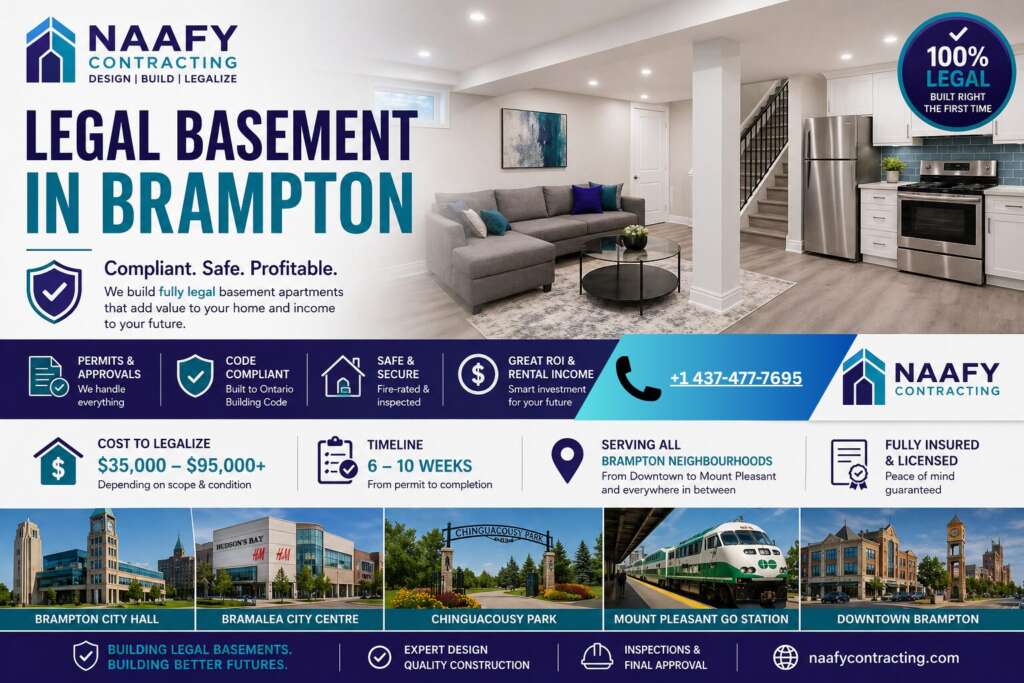
Legal Basement in Brampton
Building a legal basement in Brampton means creating a fully compliant second dwelling unit that meets the Ontario Building Code and municipal zoning bylaws. This is not just a renovation—it is a regulated construction project that requires permits, inspections, and strict safety compliance before it can be legally rented.
At Naafy Contracting, we build and legalize basement apartments across Brampton, from homes near Brampton City Hall to newer communities around Mount Pleasant GO Station. Our focus is not just construction, but delivering fully approved, income-generating units that pass inspection the first time.
What Are the Requirements for a Legal Basement in Brampton?
A legal basement in Brampton must comply with the Ontario Building Code, fire safety regulations, and local bylaws to qualify as a second dwelling unit.
In practical terms, the basement must have adequate ceiling height, a separate entrance for independent access, proper fire separation between units, and a compliant egress window for emergency escape. All electrical, plumbing, and HVAC systems must meet provincial standards and pass inspection.
In older areas such as Downtown Brampton, many homes were not originally built for secondary units. This often requires structural adjustments such as enlarging windows or modifying ceiling clearances. Without these upgrades, the basement cannot be approved as a legal unit.
How Much Does It Cost to Legalize a Basement in Brampton?
The cost of building or legalizing a basement in Brampton typically ranges from $35,000 to $95,000+, depending on the property condition and scope of work required.
Homes near Bramalea City Centre often require more upgrades due to older construction, while newer homes may already meet some structural requirements.
The main cost factors are compliance-related, including fire-rated assemblies, separate entrances, plumbing installations, and permit approvals. Finish materials play a smaller role compared to these mandatory upgrades.
From an investment perspective, a legal basement in Brampton can generate $1,200 to $2,000 per month in rental income, making it one of the most reliable ways to offset mortgage costs.
Legal Basement Permit Process in Brampton (Step-by-Step)
Legalizing a basement requires a structured approval process through the city, and each stage must be completed correctly.
The process begins with a feasibility assessment of your property, where ceiling height, layout, and zoning compliance are evaluated. This is followed by detailed architectural drawings prepared according to Ontario Building Code requirements.
Once the drawings are ready, they are submitted to the city for permit approval. After submission, homeowners can track progress using the City of Brampton’s building permit status system.
After approval, construction begins in stages. Inspections are conducted at key points such as framing, insulation, and final completion. Each stage must pass before moving forward.
Once all inspections are approved, the basement is officially recognized as a registered Two-Unit Dwelling, which is the classification used by the city for legal secondary units.
Legal Basement Zoning & Property Check in Brampton
Before starting construction, it is important to confirm whether your property qualifies for a second dwelling unit.
Homeowners can review the City of Brampton zoning map to verify eligibility. Zoning rules vary across neighborhoods and determine factors such as parking requirements, entrance placement, and unit size.
Checking zoning early helps avoid design issues and permit rejections later in the process.
How to Check If a Basement Is Legal in Brampton
A finished basement is not necessarily a legal one. To verify legality, homeowners should review building permits, inspection approvals, and fire safety compliance.
We often inspect homes where basement units were built without permits and later require reconstruction to meet code. This is especially common in older properties across Brampton.
Is a License Required to Rent a Basement in Brampton?
In Brampton, basement units must comply with zoning and building regulations to be legally rented. While not all properties require a separate licensing system, the unit must be registered and approved as a legal second dwelling.
Failure to comply can result in fines, legal notices, or forced removal of the unit.
Grants & Financial Programs for Legal Basements in Brampton
Homeowners may qualify for financial assistance programs that support basement construction and upgrades.
Programs offered by Canada Mortgage and Housing Corporation, including financing initiatives like MLI Select, are designed to support multi-unit housing and may apply to certain secondary unit projects.
The Canada Greener Homes Grant can provide rebates for insulation, air sealing, and energy-efficient upgrades, which are often part of legal basement construction.
At the municipal level, Brampton has offered support through second unit or renovation assistance programs tied to the Two-Unit Dwelling initiative. Availability may vary, so checking current programs is recommended.
Common Problems in Brampton Basement Projects
Many basement projects fail due to poor planning and lack of code compliance. Common issues include low ceiling heights, improper fire separation, and non-compliant layouts.
In neighborhoods near Chinguacousy Park and other older areas, structural limitations often require professional redesign before approval is possible.
Fixing these issues after construction has started is significantly more expensive than doing it correctly from the beginning.
Why Local Experience in Brampton Matters
Brampton has strict enforcement when it comes to basement legalization, and requirements can vary depending on the neighborhood and property type.
A contractor with local experience understands zoning restrictions, inspection expectations, and how to avoid delays in permit approvals. This ensures the project moves smoothly from design to final approval.
FAQ
A legal basement must meet Ontario Building Code standards, including proper ceiling height, fire separation, a separate entrance, and an egress window. It must also pass all city inspections.
Most projects range between $35,000 and $95,000+, depending on structural changes, permits, and compliance upgrades.
Typically between 6 to 10 weeks, depending on permit approvals and construction scope.
No. Renting an unapproved basement is illegal and can result in fines or legal action.
You can verify legality by reviewing city permits, inspection approvals, and ensuring compliance with fire and safety standards.